Self-Supervised Collapse Prevention with Score-Based Entropy Maximization
Our approach learns a parametric score model of Gaussian-smoothed embeddings to promote representation diversity. The same model also guides test-time adaptation.
From a collapsed subspace to diverse representations, while keeping views aligned.
Illustrative 2D animation · No audio
Read the animation descriptions
The intuition. Two augmented views pass through a shared encoder. Their embeddings concentrate around a diagonal line in a two-dimensional latent space. A learned score describes the smoothed distribution. The negative-score signal spreads the representations into both dimensions while alignment keeps paired views together.
The mechanism. The animation introduces the alignment and EBReg terms, adds Gaussian noise to embeddings, and visualizes the smoothed density. A score model estimates the direction toward higher density. During the encoder update, the score is held fixed and the embeddings move against it. Combined with view alignment, this encourages representation diversity. These animations illustrate the idea; they are not benchmark measurements.
01 / THE IDEA
Abstract
Alignment meets diversity. Learn the regularization signal.
Diffusion models have demonstrated the effectiveness of score-based objectives for generative modeling, yet their potential for self-supervised representation learning remains underexplored. We introduce Entropy-Based Regularization (EBReg), a framework that uses latent score estimation to regularize the latent distribution during self-supervised training.
EBReg jointly learns an encoder and a latent score model, and utilizes the learned score to provide a diversity-preserving signal that prevents representational collapse. Motivated by a mutual-information lower bound, we formulate the objective as view alignment with smoothed marginal entropy maximization and optimize the marginal entropy without explicit density evaluation.
The same score model can additionally be used at test time to refine corrupted representations toward the training latent distribution. Empirically, EBReg learns competitive representations on ImageNet-1K, achieving 75.57% linear-probe accuracy with ViT-L. Across diverse architectures, score-guided test-time adaptation further improves robustness on ImageNet-C, yielding an average relative accuracy gain of approximately 5%.
GAUSSIAN SMOOTHING
A density beyond the subspace.
Adding Gaussian noise gives the embeddings a full-dimensional density, even when the clean representations occupy a lower-dimensional subspace. This makes the smoothed entropy well-defined.
A noise-prediction network learns the score of the evolving, smoothed distribution. Its estimated score supplies entropy-promoting encoder updates and can be reused for test-time adaptation.
Encourage diversity during training. Recover structure at test time.
01
Align the views
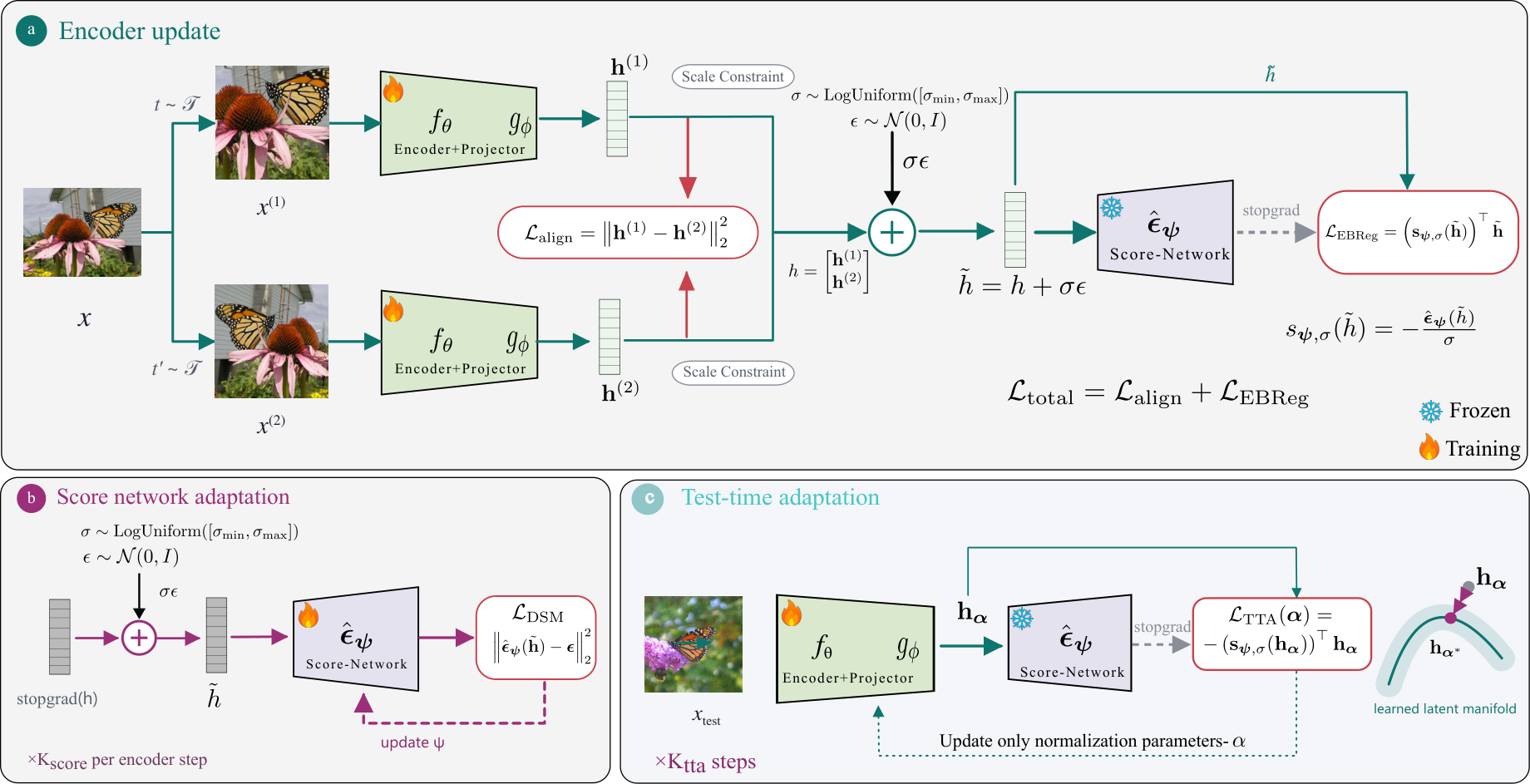
A shared encoder and projector turn two augmented views into embeddings. An alignment loss brings paired representations together.
02
Learn the latent score
Add Gaussian noise to detached embeddings and fit a noise predictor. Alternate score fitting with encoder updates.
03
Preserve diversity
Hold the score fixed and update the encoder against its direction. A scale constraint prevents entropy from increasing through rescaling alone.
Training & adaptation The encoder and score network alternate updates. At test time, the score network is frozen and only encoder normalization parameters are adapted. Figure 2 in the paper ↗
THE TRAINING OBJECTIVE
ℒtotal = ℒalign + γ 𝔼[sg(sψ,σ(h̃))⊤ h̃]
Align paired views Encourage embedding diversity
The score-based term is a gradient surrogate for entropy maximization, not a direct entropy estimate. With a learned score, the entropy-gradient equivalence is approximate.
↗ ↙
At test time, reverse the direction.
During training, move against the score to promote diversity. During adaptation, move toward higher source density using unlabeled test inputs. The score model stays frozen; only normalization parameters change.
Contrastive regularization and EBReg both encourage diversity alongside view alignment. A contrastive regularizer such as InfoNCE uses explicit negative pairs; EBReg obtains an entropy-promoting signal from a learned latent score.
Mechanisms for preserving representation diversity
Regularizer
Diversity signal
Extra learned score model
Contrastive e.g. InfoNCE
Repulsion through comparisons with negative examples.
No
VICReg
Variance floors and penalties on cross-dimensional covariance.
No
SIGReg
Distributional regularization toward an isotropic Gaussian target.
No
EBReg
A learned score of Gaussian-smoothed embeddings provides entropy-promoting updates, without explicit negative pairs.
Yes
The latent scale constraint determines EBReg’s maximum-entropy target. Some constraints yield targets connected to existing regularizers; a shared target does not make their objectives equivalent. Connections in Table 1 ↗ · Related work ↗
Training pseudocodeTwo alternating updates
For each minibatch, fit the score model on detached embeddings, then update the encoder and projector using a detached score. Embeddings are normalized before adding noise; alignment uses the clean paired views.
# 1. Fit the score model; encoder and projector stay fixed.
h_1, h_2 = normalized_embeddings(view_1, view_2)
h_bar = stopgrad(concatenate(h_1, h_2))
repeat K_score times:
    eps = standard_gaussian_like(h_bar)
    update_score_model(MSE(predict_noise(h_bar + sigma * eps), eps))

# 2. Recompute embeddings with encoder gradients; detach the score.
h_1, h_2 = normalized_embeddings(view_1, view_2)
h = concatenate(h_1, h_2)
h_noisy = h + sigma * standard_gaussian_like(h)
score = stopgrad(-predict_noise(h_noisy) / sigma)
loss = mean_squared_alignment(h_1, h_2) + gamma * mean(dot(score, h_noisy))
update_encoder_and_projector(loss)
Conceptual pseudocode, adapted from Algorithm 1. Implementation code is coming soon.
03 / THE EVIDENCE
Competitive accuracy. Richer representations.
ImageNet-1K linear evaluation Across convolutional and transformer backbones
Selected matched comparisons from Table 2. All rows use 100 pretraining epochs.
Backbone
Method / regularizer
Linear probe (%) ↑
Effective rank ↑
ResNet-50
VICReg
68.02
1,368
EBReg OURS
67.92
1,431
ViT-L
SIGReg
75.32
648
EBReg OURS
75.57
759
ViT-H
I-JEPA + StoP
79.33
527
I-JEPA + StoP + EBReg OURS
79.41
957
Comparisons are matched within each backbone’s training setup. Higher effective rank indicates less dimensional collapse. EBReg replaces the regularizer for ResNet-50 and ViT-L, and is added to the existing objective for ViT-H. Full results ↗
DESIGN CHOICES / TABLE 3
Smoothing and score fitting both matter.
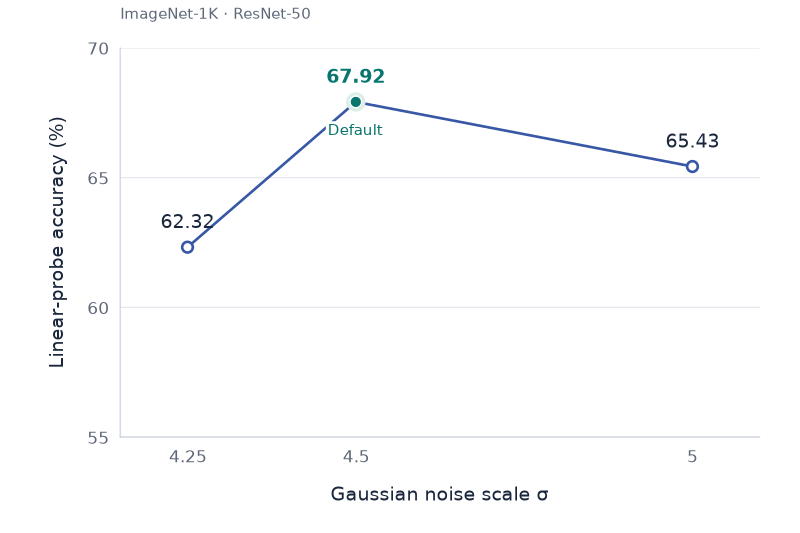
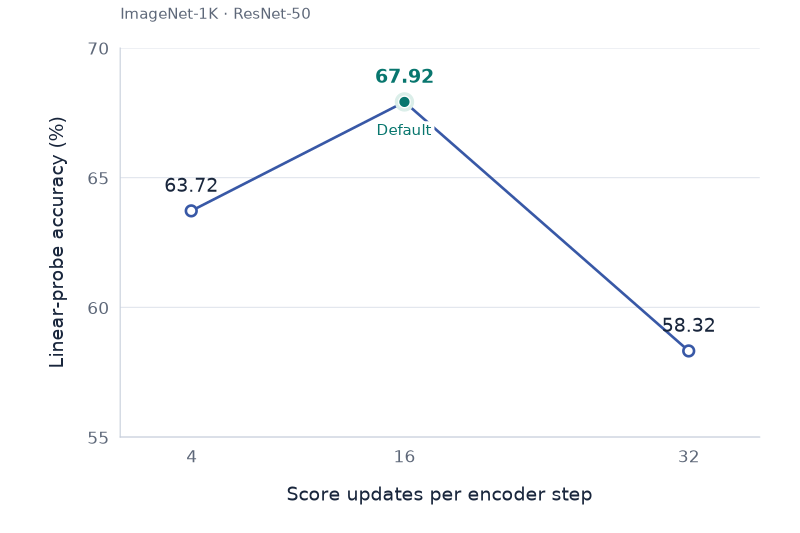
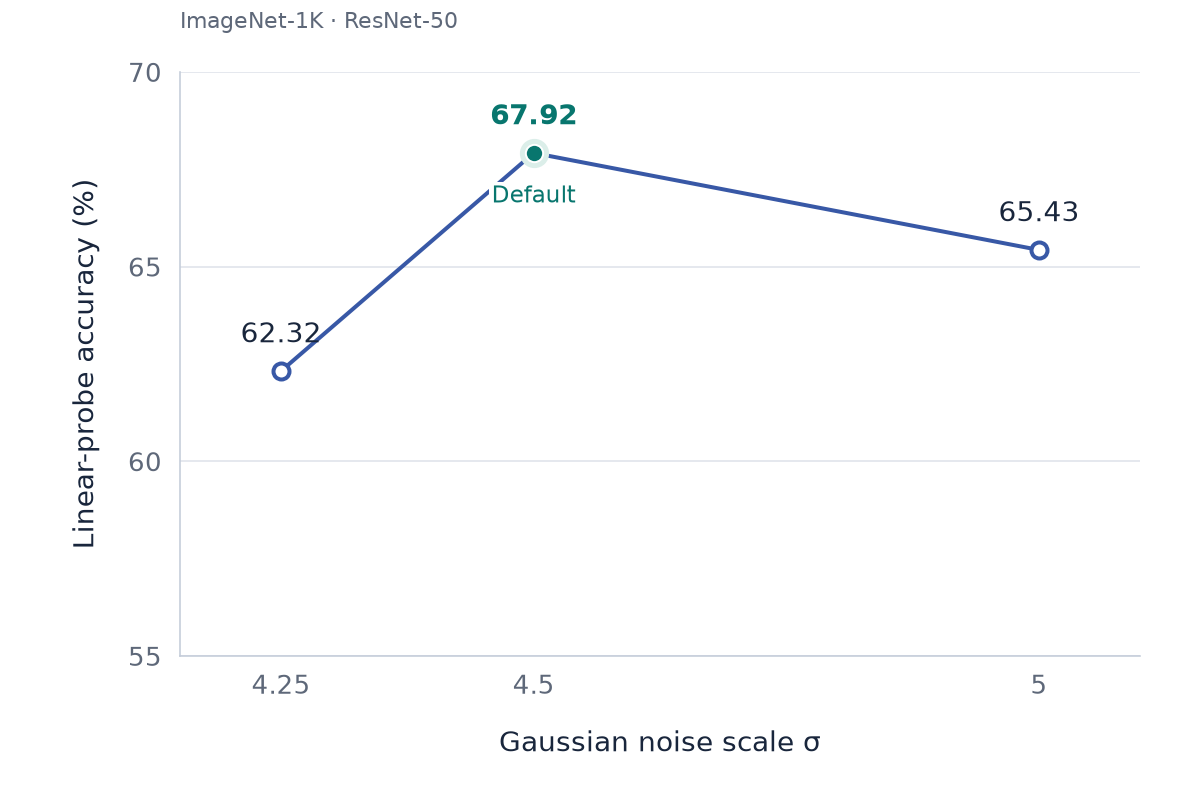
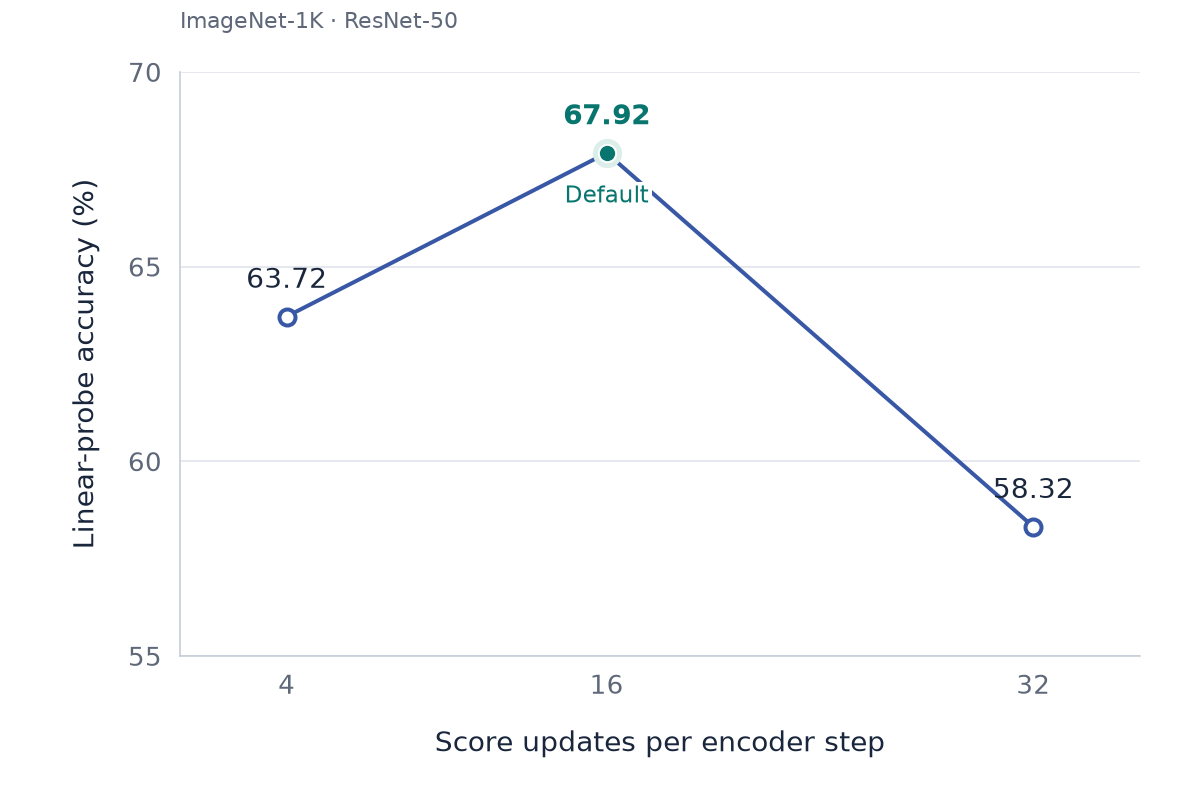
ResNet-50 linear-probe accuracy on ImageNet-1K, varying one factor at a time. The highlighted defaults perform best among the tested settings.
Gaussian noise scale
The amount of smoothing changes representation quality. Download PNG ↓
Score updates per encoder step
More score fitting does not always improve accuracy. Download PNG ↓
Both plots use the same 55–70% vertical scale. Lines connect measured settings; they are visual guides. These are sensitivity studies, not tests that remove either component. Table 3 ↗ · Download data (CSV) ↓
ROBUSTNESS UNDER DISTRIBUTION SHIFT
Five steps toward better robustness.
Mean ImageNet-C accuracy improves across all three models after five score-guided adaptation steps.
BeforeAfter adaptation
ViT-L+1.63 pp
46.55
48.18
ViT-H+3.26 pp
57.79
61.05
ResNet-50+1.83 pp
28.67
30.50
0255075100%
Averages cover all 15 corruptions; pp denotes percentage points. The approximately 5% headline is an average relative accuracy gain across models. Table 5 ↗
Training cost & scope
In the paper’s ViT-L comparison, EBReg adds a 5.21M-parameter score network. Training takes 500 seconds per epoch versus 440 seconds for SIGReg, with peak memory of 89.84 GB versus 90.33 GB on identical hardware (Table 4). The theoretical analysis of low-variance directions assumes an exact score and specific distributional conditions; the illustrative animations are not a guarantee of recovery from exact collapse.
04 / BUILD ON THIS WORK
Citation
If you find this work useful, please consider citing our paper.
BibTeX
@misc{kappiyath2026selfsupervised,
  title   = {Self-Supervised Collapse Prevention with
             Score-Based Entropy Maximization},
  author  = {Adarsh Kappiyath and
             Silpa Vadakkeeveetil Sreelatha and
             Xiatian Zhu and Yann LeCun and
             Lu Yin and Amir Bar},
  year    = {2026},
  eprint  = {2611.11379},
  archivePrefix = {arXiv},
  primaryClass  = {cs.LG},
  url     = {https://arxiv.org/abs/2611.11379}
}